
There is a kind of morning that doesn’t look like a problem from the outside.
Kitchen table. Cooling coffee. Laptop open.
You scroll through your own notes. Past essays, course materials, things you’ve written about listening to your body. Honoring limits. Building a life your nervous system can actually sustain.
The sentences still ring true. You remember what it felt like to write them. For a moment, reading yourself, you feel aligned.
Then you flip to today’s calendar.
Back-to-back sessions. No real gaps. A “quick” check-in jammed into lunch. A workout squeezed into the one slot your brain is usually sludge. An evening commitment you already know will cost tomorrow’s morning.
Your chest feels heavier looking at the calendar than it did reading your own words.
You do not change the calendar.
You tell yourself you’ll fix things once it calms down. You close the laptop and start the day.
If you’re honest, this isn’t an isolated morning. It’s one tile in a repeating pattern. You know what you should do. You understand why. You don’t do it.
This essay is about why.
The GPS That Runs Your Life
Your intellect is not the decision-maker you think it is.
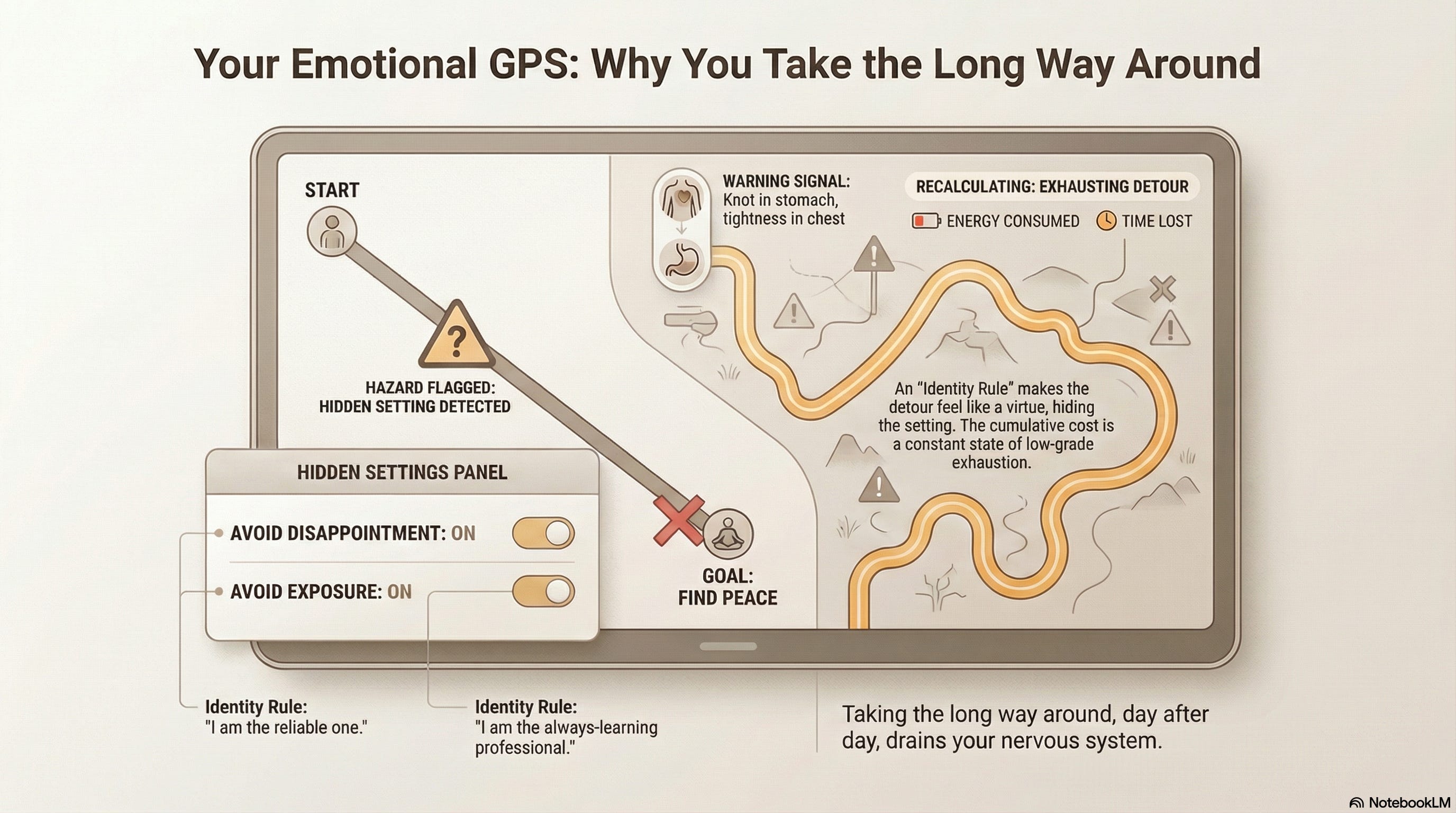
Think of it as a GPS. Brilliant at calculating routes. Give it a destination—feel at peace, feel competent, feel secure—and it will map the fastest path.
But a GPS calculates routes based on settings you’ve enabled. And somewhere in your system, settings got toggled that you never consciously chose.
Avoid Conflict: ON Avoid Disappointment: ON Avoid Exposure: ON
These aren’t preferences you selected. They were installed by experiences you may not even remember. A moment where conflict felt dangerous. A time when disappointing someone cost you something essential. An exposure that felt like annihilation.
Your GPS doesn’t know those moments are decades old. It just knows the settings are active.
So when you look at your calendar and feel the pull to cancel a meeting, your system runs the calculation. The direct route to peace—canceling—passes through “Disappointment.” The setting flags it as a hazard.
The GPS recalculates.
New route: Keep the meeting. Squeeze the workout. Skip lunch. Promise yourself rest later. This path avoids the flagged zone. It’s longer. It costs more fuel. But it doesn’t trigger the setting.
You aren’t stuck because you lack insight.
You’re exhausted because you’re taking the long way around feelings your system marked “Do Not Enter.”
The Menu That Hides the Settings
If the settings were visible, you’d question them.
So your system builds a menu on top. A layer of identity that makes the constraint feel like a choice. This is what keeps the settings hidden in plain sight.
The setting “Avoid Disappointment” doesn’t announce itself. Instead, you experience it as:
“I am the reliable one.”
This feels like a value. A point of pride. The kind of person you’ve worked to become. But watch what it actually does.
When the calendar presents an obvious candidate for cancellation, “I am the reliable one” steps in before you can evaluate. The question isn’t “Does this meeting serve me?” The question becomes “What kind of person cancels?”
The setting stays hidden. The route stays long. The identity rule takes the blame for a constraint you never consciously chose.
A Second Example
There’s another version that runs in professionals who’ve done the work.
The setting is “Avoid Exposure”—the fear of being caught not knowing, not being enough, being revealed as less than competent.
The identity rule that hides it:
“I am the always-learning professional.”
This also feels like a virtue. Growth mindset. Continuous improvement. But watch what it does in practice.
You already have more frameworks than you can implement. More notes than you’ve reviewed. More courses than you’ve finished. The direct route to competence would be sitting with what you know and discovering where your actual edges are.
That requires tolerating uncertainty. Sitting in the gap between what you’ve learned and what you’ve embodied. Your system has uncertainty flagged as dangerous—too close to exposure.
So the GPS recalculates.
New route: Buy the next course. Save the next thread. Collect more frameworks. Activity substitutes for presence. Forward motion replaces the stillness that might reveal the gap.
“I am the always-learning professional” makes this feel like growth. But the setting underneath hasn’t changed. You’re still routing around exposure. The miles add up.
The Moment of Recognition
The pattern becomes visible in small moments.
You consider canceling. Before you can weigh it honestly, something drops in your stomach. Tightens in your chest. A flash of “I can’t do that.”
That’s not rational evaluation. That’s the setting activating. The GPS flagging a hazard before you reach it.
Or: You look at the course you haven’t finished. The direct path is closing the tab and working with what you have. Before you can consider it, restlessness rises. A pull toward something new. A sense that you’re not ready yet.
That’s not curiosity. That’s the detour engaging. The system finding another route around the flagged zone.
The body confirms what the intellect hides. The tightness, the drop, the restlessness—these are the somatic signatures of a setting activating. The identity rule provides the narrative: “I’m being responsible.” “I’m committed to growth.” But the body tells the truth about the constraint.
Why This Matters
Every time you take the long route, you pay for the distance.
Muscles brace. Breath shortens. The nervous system shifts toward vigilance. On its own, each instance is small. Seconds of tension.
Multiply it by every day of the overloaded calendar. Every “yes” that was a “no.” Every course purchased to avoid sitting with uncertainty. Every conflict smoothed to protect a setting you never chose.
The result: a baseline hum that never quite settles. The gap between what you know and how you live. The exhaustion that doesn’t match the effort.
You aren’t failing to apply what you understand.
You’re running a navigation system with settings that route you away from the shortest path—and identity rules that make the detour feel like virtue.
What Comes Next
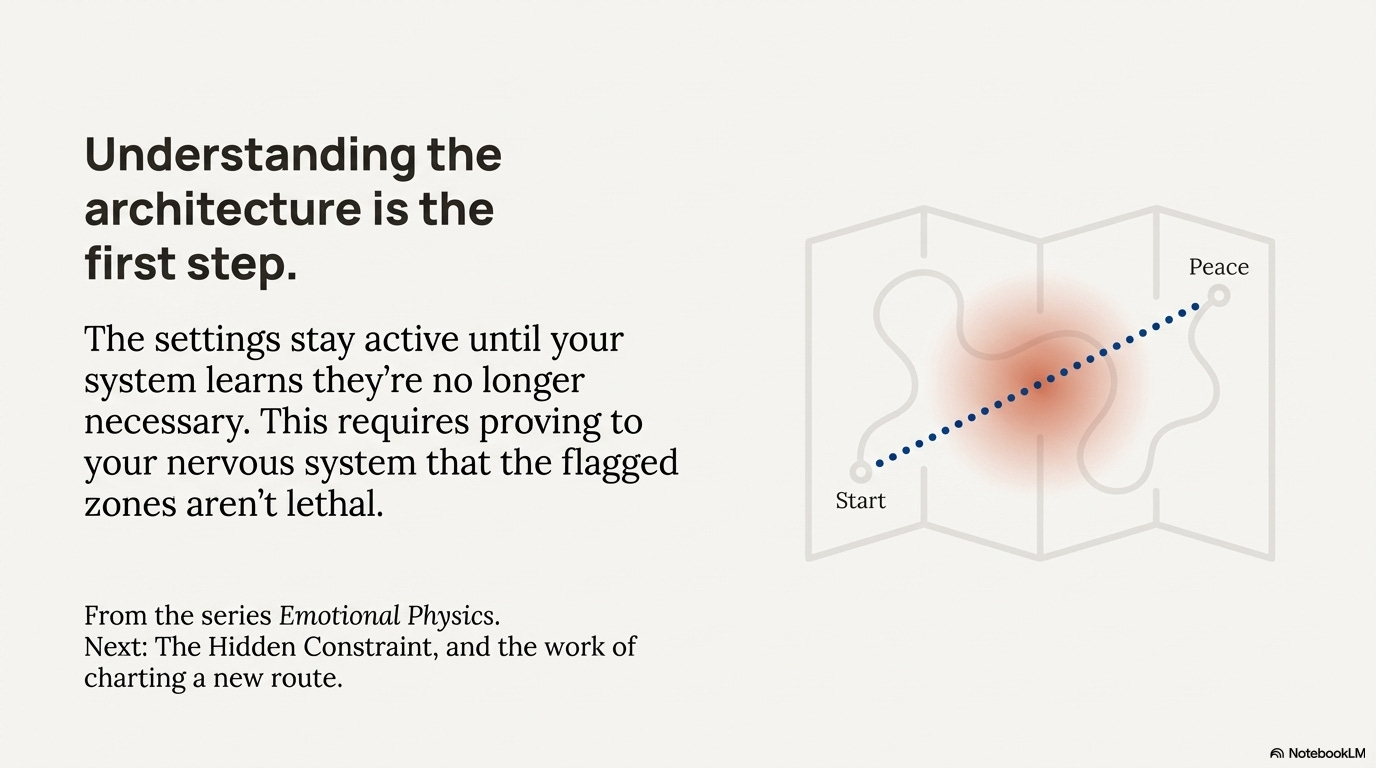
Seeing the settings is the first step. But understanding the architecture doesn’t change the route.
The settings stay active until the system learns they’re no longer necessary. That requires something more than insight. It requires proving to your nervous system that the flagged zones aren’t actually lethal. That you can feel the disappointment, the exposure, the conflict—and remain intact.
That’s the work of the next essay: the mechanism that enforces these settings, the cost you’ve been paying, and how to test whether the old routes still serve.
For now, one question is enough:
What setting is running that you’ve been calling a value?
The ideas in this series draw on work by Joe Hudson, Zivorad Slavinski, Stevie Kent, and Dr. Joan Ifland. The synthesis, framework, and application here are my own.
This is the first of two essays on Emotional Physics—the hidden architecture that determines why knowing better rarely changes anything. Next: The Hidden Constraint, and what it actually costs to take the long way around.