
It is 6:15 PM. You close the laptop. The screen goes black.
This should be the moment the switch flips. The respected leader becomes the present partner, the calm parent. But you don’t move. You sit there with a low-grade hum running through your chest. You feel the phantom buzz in your pocket—the urge to check Slack or email even though you just cleared them. There is no new message. The threat isn’t real. But the urgency is.
You just spent eight hours running flat-out. Responding. Handling. Productive by any measure.
So why do you feel like you drove all day in first gear? Why is your chest tight, your energy spent, yet your mind too wired to rest?
The exhaustion you feel is not from the work.
It is from a structural detour your nervous system has been forcing you to take.
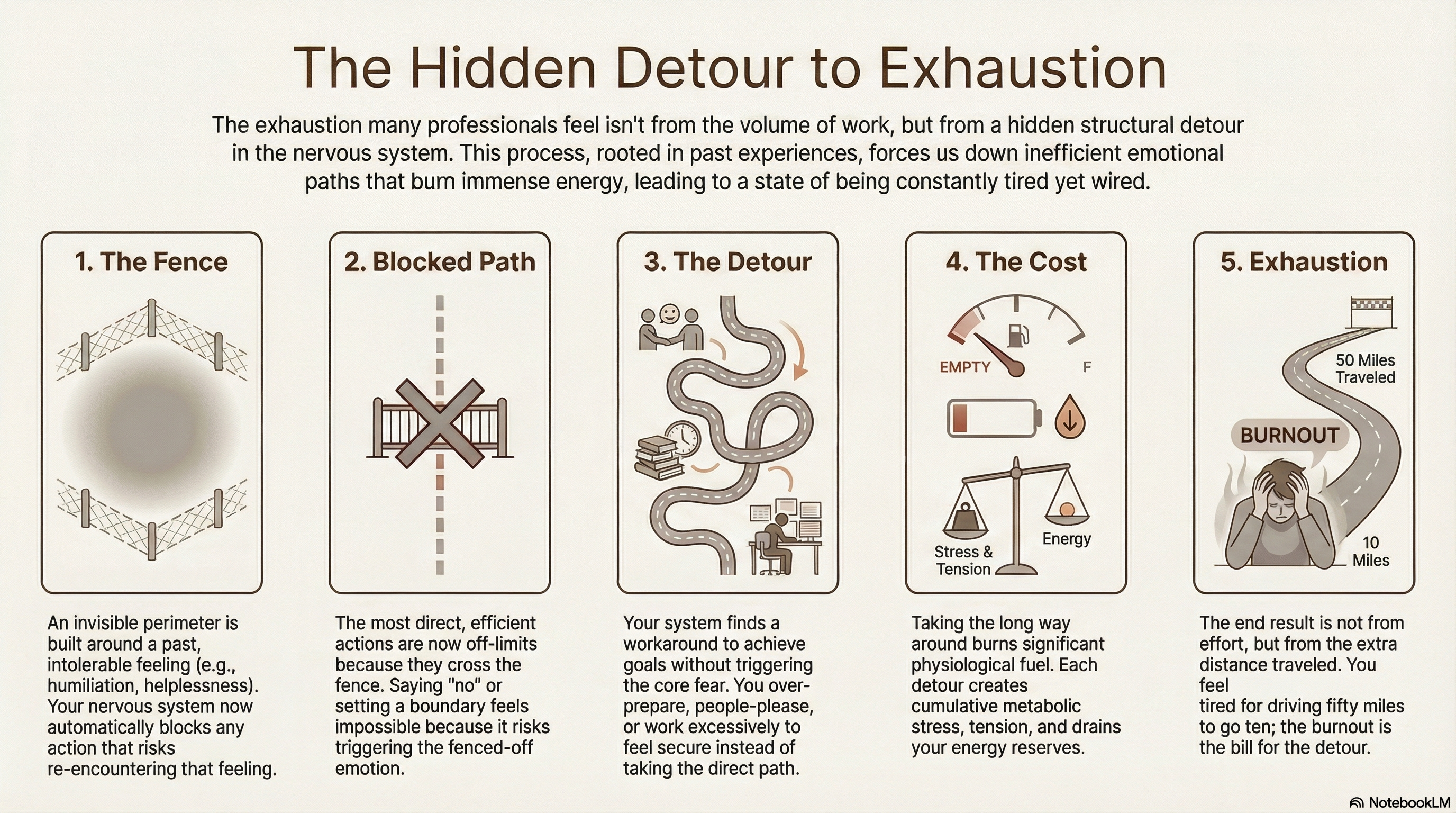
The Electrified Fence
In the previous essay, The Hidden Setting, we looked at the avoidance toggles your system runs without your awareness—disguised by identity rules like “I am the reliable one.”
This essay is about how those settings get enforced. And what the enforcement costs.
Somewhere in your history, your system encountered something it could not tolerate. A moment of exposure. A humiliation. A helplessness that felt like annihilation. The content matters less than what happened next.
Your nervous system installed a perimeter around that experience. An invisible, electrified fence. From that point forward, any action that risks re-encountering that feeling gets blocked before you consciously consider it.
This quarantined area is quietly marked as your nervous system’s no-go zone.
This isn’t metaphor. It’s how survival systems work. The brain doesn’t distinguish well between the board meeting and the childhood incident. It generalizes. The fence expands. Soon it cuts off not just the original danger, but entire categories of direct action: setting a boundary, admitting uncertainty, saying no without justification.
The fence is the first domino.
The Blocked Path
Here is what the fence does in practice.
You want peace. Rest. Clarity. The direct route is obvious: cancel the meeting that doesn’t need to happen. Say no to the commitment you already resent. Send the three-sentence email instead of the hedge-filled paragraph.
But the direct route passes through fenced territory.
Canceling means risking disappointment. Saying no means risking conflict. The honest email means risking rejection.
Your system scans the route, sees the fence, and blocks the path before you consciously weigh the options. The decision not to cancel doesn’t feel like a decision. It feels like reality. Of course you can’t cancel. Of course you have to go. Of course the email needs softening.
The identity rules from the previous essay—”I am the reliable one,” “I am the always-learning professional”—are the stories your intellect tells to explain why the blocked path was never really an option.
The blocked path is the second domino.
The Detour
With the direct route closed, your system finds an alternative.
If the straight line to “feel secure” passes through shame, the route recalculates. The new path: achieve so thoroughly, prepare so completely, respond so reliably that the original vulnerability can never surface. Become unassailable.
This is the detour. Not a character flaw. Not poor time management. A navigation workaround your system built to avoid a feeling it decided you could not survive.
The back-to-back meetings are the detour. The inbox vigilance is the detour. The “yes” that was actually a “no” is the detour. Each one adds distance to your day because the direct road is closed.
The detour is the third domino.
The Cost
Distance requires fuel.
Every time the throat clamps instead of speaking. Every time muscles brace instead of moving an appointment. Every time you override fatigue with caffeine because rest would mean sitting with what you’ve been outrunning.
Physiological currency gets spent.
On its own, each instance is small. Seconds to minutes of tension.
But multiply it across every day. Every week. Every year of the overloaded schedule. Every “yes” that was a “no.” Every conflict smoothed instead of allowed to move.
The result: baseline tension that never quite drops. Sleep that looks fine on a tracker but never restores. Nervous system metrics that respond to techniques, then fall back when you reenter certain relationships or patterns. Gut symptoms that flare predictably around specific conversations, even when food is dialed in.
The detour is expensive. And you’ve been paying for it every day without knowing why.
The cost is the fourth domino.
The Exhaustion
Now the 6:15 PM moment makes sense.
You are not tired because the work was hard. You are tired because you drove fifty miles to travel ten. The phantom buzz is your system scanning the perimeter, confirming the fence still holds. The tight chest is the metabolic bill for a day spent parallel to a barrier you cannot see.
The exhaustion was never about effort. It was about distance.
This is the fifth domino—the one you actually feel.
Same Structure, Different Surface
Once you see the chain, you see it everywhere.
You’re on a sales page for another training. The direct route to competence would be sitting with what you already know and finding your actual edges. That requires tolerating uncertainty. Uncertainty is fenced.
So you click Enroll. Activity substitutes for presence. Forward motion replaces the stillness that might expose the gap.
Or: You have an email drafted. The honest version is three sentences. The direct path is clarity, which risks disagreement. Rejection is fenced.
So you soften. Hedge. Add paragraphs. By the time you send it, the message says almost nothing.
Different surfaces. Same physics. Fence blocks direct path. System routes around. Fuel gets burned. Exhaustion follows.
Testing the Fence
No worldview required. Just an experiment.
The work here is subtle but powerful. Savor this time with a real situation you are in now. It’s the soil where epiphanies sprout.
Start with something small. A recurring commitment that drains. An email that keeps getting edited. A tab that keeps getting opened.
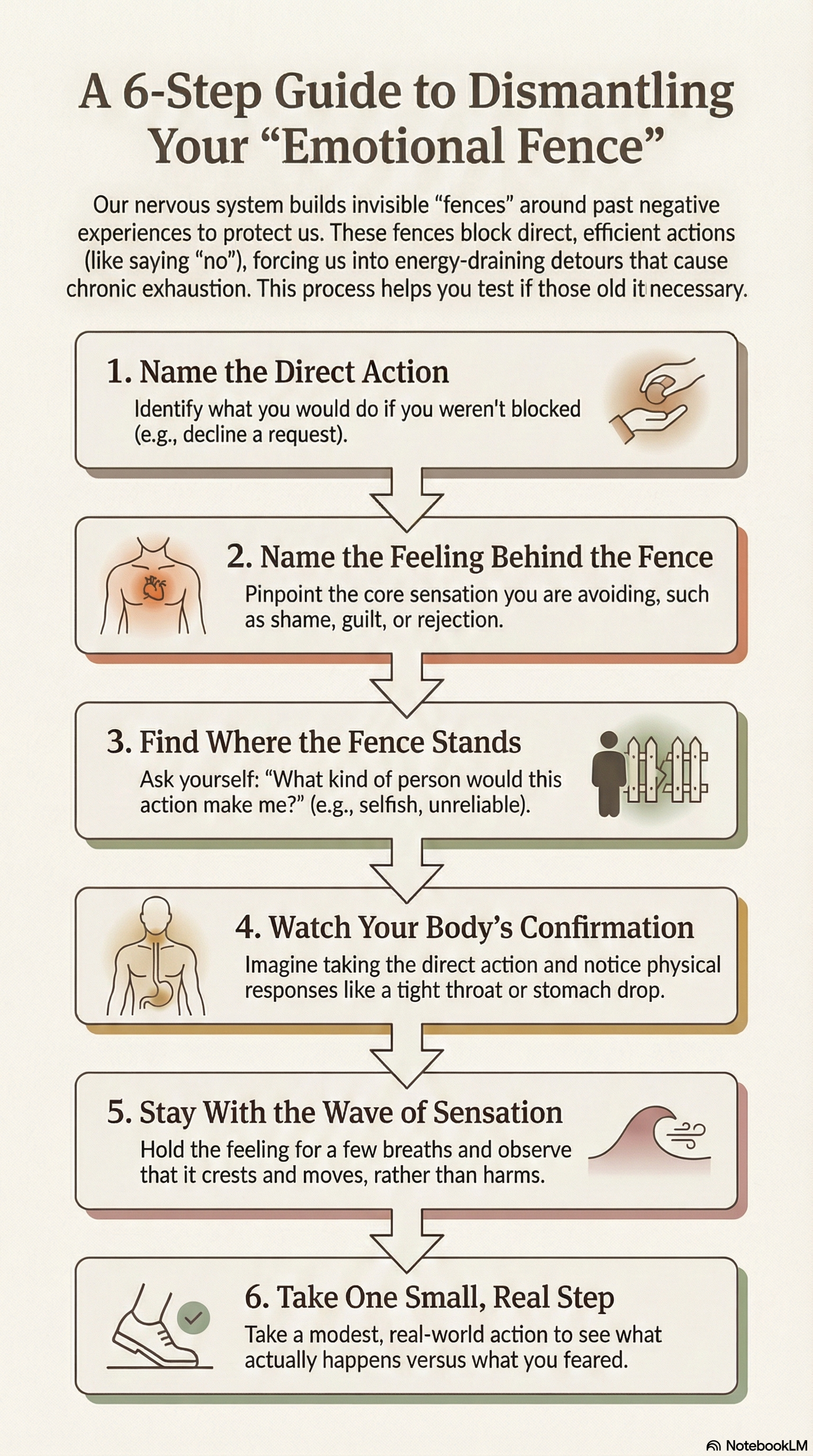
Name the direct action.
If you did what you actually wanted, what would happen? Move this meeting. Decline this request. Send the short version. Close the tab.
Name the feeling behind the fence.
What is the worst thing you would feel if you did it? Not the story. The sensation. Guilt. Shame. Rejection. Exposure.
Find where the fence stands.
Ask: If I did that, what kind of person would that make me?
Listen for the quiet sentence. “That would make me unreliable.” “That would make me selfish.” That sentence marks the fence.
Watch the body confirm it.
Without changing anything yet, imagine the direct action. Sending the email. Saying no. Moving the meeting.
Notice where the body responds. Throat tightens. Stomach drops. The urge to soften, apologize, hedge.
That’s the system confirming the fence is live.
Stay with the wave.
This is the experiment. Not forcing action. Simpler.
Stay with the sensation a few breaths longer than usual. Let the feeling crest. Guilt. Shame. Exposure.
Ask: Does it kill me, or does it move?
If even a slightly larger dose becomes tolerable, your system has new data. “I can feel this and stay intact.”
That is the fence starting to come down.
Take one step.
Only then, take a real action scaled to current capacity. Move one thing. Add one honest sentence. Say no where the stakes are modest.
Watch what happens. Sometimes the feared response materializes. Usually it doesn’t.
Either way, clean information emerges. What the body predicted versus what unfolded.
Repeat across different patterns. The internal narrative shifts from “I cannot do that” to “I have been protecting an old perimeter. I can test whether it still needs to stand.”
Most approaches to health focus on managing what’s wrong. Adjusting symptoms, optimizing metrics, adding protocols. This work is different: locate what’s blocking the system from functioning on its own, then remove the block.
No new technique gets installed. An old barrier gets examined.
That is emotional physics.
It explains why smart, informed people stay stuck in patterns they could write essays about. The intellect understands. The body is still routing around a fence it installed decades ago.
The exhaustion was never about working too hard.
It was about the distance.
This essay is part of a larger framework being built at Health Under Control, one that applies the same logic across physiology and psychology. If this way of thinking resonates, there’s more here.
The ideas in this series draw on work by Joe Hudson, Zivorad Slavinski, Stevie Kent, and Dr. Joan Ifland. The synthesis, framework, and application here are my own. Any distortions or errors are mine, not theirs.
This essay explores a core application of HUC Principle 3: Removing Hidden Blocks over Managing Symptoms. The work isn’t adding another layer of management. It’s locating the constraint that’s been running underneath—and testing whether it still needs to stand.
For the foundational framework behind this approach, see The HUC Principles and Five Stages of Health.