
The Parking Lot Calculation
There was a time I could predict, within fifteen minutes, when the next wave would hit.
I’d learned to leave work early. Not to go home—I couldn’t make it that far. I’d drive across the street to a parking lot facing the ER entrance, pull into the back corner, and curl up in the driver’s seat. Waiting. Calculating whether this time would be the time I’d actually walk through those doors.
I never did. Not willingly.
I had no diagnosis yet. Just patterns. Skip breakfast, avoid lunch, don’t eat anything that required digestion before 4 PM. Track bathroom trips. Notice the correlation between stress and inflammation. Learn which positions reduced pain. Master the art of looking fine.
My wife noticed first. The questions started gentle, then persistent. Eventually, I stopped pretending and dumped a year’s worth of notes, logs, and sketches of my own abdomen into the hands of a GI specialist.
Another year of tests followed. Scopes, biopsies, blood work, imaging. And then the word: Crohn’s.
The diagnosis wasn’t clean. It never is. Symptoms overlap. Tests miss things. Some people spend years getting tested for IBS, then IBD, then something else entirely before landing on a label that fits well enough to move forward. In my case, the biopsies and imaging pointed to Crohn’s. But the terrain—gut dysbiosis, stress response, inflammatory patterns—was more complex than any single diagnosis could capture. The label gave direction. It just didn’t tell the whole story.
“You don’t want it to be Crohn’s,” (my GI physician said early on).
But it was.
The Relief and Trap of Having a Name
The diagnosis was a doorway. I walked through it with relief and desperation.
Relief: I wasn’t imagining it. The pain had a source, a mechanism, a category. I could stop defending myself to people who thought I was exaggerating or anxious or just needed to relax.
Desperation: Now what?
The answer came in prescriptions. Pentasa. Prednisone. Rounds of other medications I can’t remember the names of anymore. And honestly, some of them helped. At least initially. The inflammation quieted. I could eat without calculating the timing. I could leave the house without mapping every bathroom between here and there.
But the face in the mirror started changing. Puffy, exhausted, less like me. And still, beneath the chemical suppression, pain lurked.
I did what patients are told to do: follow the protocol. The problem is, that protocol didn’t include me—not the way I knew myself. Not the way I’d already begun to track, adapt, experiment on my own. The medications weren’t useless. But the model—treat the disease, suppress the symptom, defer to the specialist—was incomplete.
So I kept my own records. Food logs, pain cycles, elimination trials. I brought them to a highly recommended specialist, hoping he’d see what I was seeing.
He glanced at my notes and said: “That has nothing to do with it.”
That sentence still echoes. Not because I was hurt. But because it clarified something I didn’t want to admit: the expert model couldn’t take me any farther.
How This Connects to HUC Principles
This essay demonstrates “hidden blocks” in action—the principle that health isn’t built by adding more techniques, but by uncovering what’s preventing the body from doing what it already knows how to do.
Note: If you’re new here, the wider frame for this whole model is in Health from First Principles — the essay that explains why doing health “right” often becomes the interference.
Each stage of this arc reveals a different kind of block:
Stage 1 reveals that the symptom isn’t the problem—it’s the signal of something deeper.
Stage 2 reveals that diagnosis, while clarifying, can become its own cage if it replaces inquiry with compliance.
Stage 3 reveals that even sophisticated protocols can mask the same control reflex that kept you sick.
Stage 4 reveals that the need to optimize was itself the interference.
Stage 5 reveals that the body was never broken. It was just interrupted.
This is how revealed blocks works across all HUC practices. Whether we’re interpreting a stool test, teaching breath regulation, or working through an emotional pattern, the question is always: what’s actually blocking this system from self-correcting?
The answer is rarely what we think. And it’s almost never solved by adding more.
The Five Stages
Most people don’t leap from dysfunction to freedom. We walk it in stages, often more than once, across different domains of health. What follows isn’t just my arc—it’s one I’ve now seen in dozens of others.
The names vary. The particulars shift. But the shape is surprisingly constant.
Here’s the map:
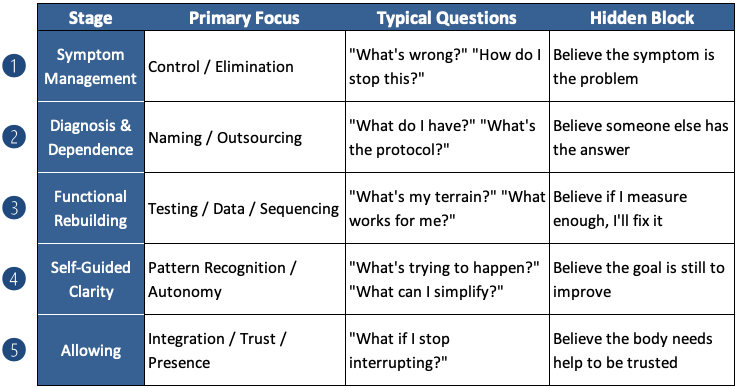
Let me walk you through each one.
Stage 1: Symptom Management — When Health Means Not Feeling Bad
Most of us start here. For months, maybe years, you’re simply trying to outrun pain. You have no framework. Only strategies.
This is where I lived in that parking lot. No diagnosis, no expert, just the raw feedback loop of pain and avoidance. I wasn’t trying to heal. I was trying to survive the next four hours.
Symptom management isn’t ignorant. It’s adaptive. You learn what triggers flares. You develop rituals. You become an expert in your own dysfunction. The problem is, expertise in dysfunction isn’t the same as understanding health.
The hidden block: believing the symptom is the problem.
It’s not. The symptom is the signal. But when you’re in Stage 1, that distinction is invisible. All you see is what hurts.
For practitioners: Clients in this stage need relief before they can engage with root causes. If you skip this step and go straight to “let’s rebuild your gut microbiome,” they’ll hear it as dismissive. Meet them where they are. Provide tools for immediate relief. Then, when the system has space, introduce Stage 3 thinking.
Stage 2: Diagnosis and Dependence — The Comfort and Cost of Having a Name
The diagnosis is a doorway. It gives language to what was previously just sensation. It connects you to protocols, research, communities of people who get it.
This stage often feels like progress. And in some ways, it is. Diagnosis provides direction. It ends the gaslighting … both from others and yourself. You’re not making it up. The scans show it. The biopsy confirms it. The label fits.
But diagnosis also creates a new block: the belief that someone else has the answer.
The expert knows. The protocol exists. Your job is to comply. This works until it doesn’t. For me, it stopped working the moment that specialist dismissed my observations because they didn’t fit his model.
The hidden block: outsourcing authority.
Medicine is built on this model. The physician diagnoses. The patient complies. There’s value in expertise—I’m not advocating for rejecting medical knowledge. But when compliance replaces inquiry, when the protocol becomes more important than the feedback your body is giving you, you’re stuck.
For practitioners: This is where many clients arrive at your door. They have the diagnosis. They’ve tried the standard protocols. And they’re still stuck. Your role isn’t to replace their doctor. It’s to restore their agency. Show them that their observations matter. That their experiments have value. That they’re the primary instrument in their own healing.
For Stage 4 clients reading this: You’ve been here. You know the relief and the ceiling. Notice if you’re recreating this dynamic with functional practitioners—trading one authority figure for another, just with better labs.
Stage 3: Functional Rebuilding — The Phase of Control That Feels Like Freedom
This is where I built Health Under Control. Not the business—the methodology.
I didn’t reject medicine. I stepped into the part of healing medicine wasn’t built to address: the terrain.
I measured stress resilience with Heart Rate Variability (HRV) every morning. I tracked BOLT scores to assess CO2 tolerance and metabolic flexibility. I studied GI-MAP stool test microbiome data like an engineer reverse-engineering his own system. I eliminated foods, reintroduced them, journaled reactions. I discovered that gut rest—actual 24-48 hour fasts—quieted inflammation when nothing else did.
I created spreadsheets. Not because I’m obsessive (though I am), but because when pain is your baseline, even a little clarity feels like rescue.
This wasn’t wellness-as-performance. It was stabilization-as-survival. I wasn’t trying to biohack my way to optimization. I was trying to decode what my body had been saying all along.
And it worked. The inflammation stabilized. The pain receded. I could eat most foods without consequence. My energy returned. My sleep improved. For the first time in years, I felt like I was building health instead of managing disease.
Looking back, I now see I was still in control mode. Just with better tools. But for a time, that kind of control was empowering. It’s what I needed.
The hidden block: believing if I measure enough, I’ll fix it.
And then, quietly, the structure starts to feel like maintenance. The protocols that once felt liberating—HRV tracking, elimination diets, quarterly labs—begin to feel routine. Not wrong. Just... mechanical. The novelty wears off. You’re healthier, but you’re also a little bored. A little tired of the system you built.
This isn’t failure. It’s completion. The structure did its job. It stabilized the terrain. Now it’s asking: what’s next?
Stage 3 is sophisticated. It’s personalized. It’s data-driven. And it works—until it becomes its own cage. The protocols stack. The testing never ends. You can’t relax because relaxation isn’t measurable. You’ve traded pill dependence for supplement dependence, doctor visits for quarterly lab panels, symptom suppression for terrain optimization.
You’re healthier. But you’re not free.
For practitioners: Most of your clients will spend significant time here. This is appropriate. Stage 3 provides the structure that allows later stages to emerge. Don’t rush them out of it. But also don’t let them build an identity around it.
Watch for the signs: protocol stacking without discernment, testing that’s become compulsive rather than clarifying, difficulty simplifying even when improvement is obvious. That’s when Stage 4 starts knocking.
Stage 4: Self-Guided Clarity — When Simplicity Starts to Speak
The shift from Stage 3 to Stage 4 is subtle. It’s not a technique change. It’s a question change.
Instead of “What else should I try?” you start asking “What can I stop?”
Instead of “What’s the next test?” you ask “What’s the pattern trying to show me?”
Instead of “How do I optimize this?” you ask “What happens if I just... let it be?”
For me, this phase began when I felt health not as absence-of-pain but as presence-of-trust.
I didn’t need as many supplements. I was no longer afraid of food. I still tested—but out of curiosity, not fear. When I re-tested my GI-MAP, I wasn’t hoping to find the missing piece. I was confirming what I already felt: the terrain had stabilized.
I started noticing breath rhythms not because I needed to “fix” them, but because I could feel when they were off. That’s when the philosophy of Health Under Control reached its endpoint.
It had done its job. The system was stable. The feedback loops were working. But the need to fix was gone.
Instead, I was paying attention to what was underneath the fixing: urgency, vigilance, the identity of being “the one who tracks and optimizes.”
The hidden block: believing the goal is still to improve.
Stage 4 is where you realize improvement isn’t the point anymore. Coherence is. Integration. The ability to sense what’s real without needing external validation.
This is where the arc quietly bends toward Stage 5: not as a new system, but as a surrender of system where it’s no longer needed.
For practitioners: Stage 4 clients are your easiest and your hardest. Easiest because they don’t need much—mostly just reflection and permission. Hardest because they’re no longer interested in protocols. They’re looking for something you can’t give them: the courage to trust what they already know.
Your role here is presence, not teaching. Ask better questions. Reflect what you see. Don’t try to give them a new framework. Help them see through the one they’re still carrying.
For Stage 4 clients reading this: You already know what I’m talking about. The question isn’t what to do next. It’s whether you’re willing to stop doing and just... be with what’s here.
Stage 5: Allowing — What Emerges When You Stop Interrupting
Joe Hudson, coach and founder of The Art of Accomplishment, is one such approach that passes the filters inherently created when the HUC principles are applied to modalities. His work focuses on how transformation begins when you stop protecting against sensation. That’s what I began to feel in my body—not as a theory, but as a lived nervous system experience.
When I stopped managing my breath, it deepened. When I stopped correcting my posture, it aligned. When I let go of managing inflammation, it stabilized.
I don’t mean passivity. I mean presence.
This phase is subtle. It’s where many high-functioning people stop short. Because there’s no gold star for not trying so hard.
Allowing health means the experiment becomes an expression, not an emergency. Health isn’t won. It’s remembered.
And it is remembered, I now believe, only when the system no longer feels interrupted.
The hidden block: believing the body needs help to be trusted.
This is the final reveal. The body was never broken. It was responding—perfectly, elegantly—to the conditions it was in. Remove the interruptions (the urgency, the control, the constant improvement project), and it does what it always knew how to do.
This is where Unblocked Health lives. Not as the opposite of structure—but as what arises when structure has served its purpose and steps aside.
For practitioners: Very few clients reach this stage while still in active treatment. And that’s fine. Stage 5 isn’t a destination you guide people toward. It’s a recognition that emerges when everything else falls away.
If you see it happening, don’t make it special. Don’t create a new protocol around “allowing.” Just witness it. Reflect it back. Let them know it’s real.
What Gets Revealed at Each Stage
The blocks aren’t obstacles to overcome. They’re protections that served a purpose. Each stage builds capacity. Each stage teaches something essential. The mistake is thinking any stage is the end.
Here’s what actually shifts:
Stage 1 → 2: You stop fighting the symptom and start understanding the system.
Stage 2 → 3: You stop deferring to external authority and start trusting your own observation.
Stage 3 → 4: You stop measuring everything and start sensing patterns.
Stage 4 → 5: You stop trying to improve and start allowing integration.
The progression isn’t linear. You can be in Stage 5 with your diet and Stage 2 with your sleep. You can master breath regulation (Stage 4) while still dependent on supplements (Stage 2). The domains don’t move in lockstep.
But the pattern repeats. And once you see it, you stop mistaking stages for identity.
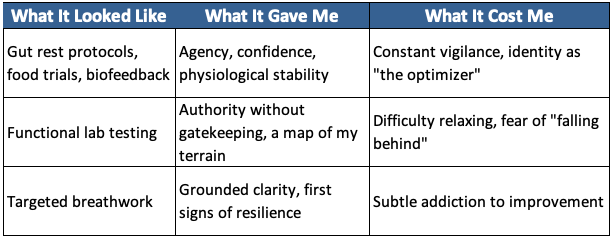
The Tables: A Detailed View
Here’s a more detailed breakdown of what each stage looks like in practice:
Control Mode (Stage 3 - Functional Phase)
Letting Go (Stage 4-5 Transition)
Implications for Practice
If you’re a practitioner, understanding these stages changes how you work:
Stage 1 clients need relief tools. Give them something that works now. Symptom management isn’t beneath you. It’s the foundation of trust.
Stage 2 clients need education and permission. They’re learning to observe. Teach them what to look for. Show them their observations matter.
Stage 3 clients need structure and personalization. This is where HUC methodology lives. Testing, sequencing, data interpretation. Do this well. But don’t let them (or yourself) mistake this stage for the endpoint.
Your primary question shifts here from “What’s wrong?” to “What’s blocking this system from self-correcting?” That question changes everything. It moves you from symptom management to terrain restoration. And it prepares both you and the client for the recognition that eventually, the protocols themselves might become the interference.
Stage 4 clients need reflection and space. Stop teaching. Start asking. They already know more than they think. Your job is to help them trust what they’re sensing.
Stage 5 clients don’t need you. And that’s the point. If someone reaches this stage, celebrate it. Don’t try to keep them in your practice. They’ve graduated.
Closing the Loop—But Not the Work
So many people live forever in the middle stages. Either stuck in management or caught in endless rebuilding. I understand why. It feels safer. There’s a checklist. A theory. A set of tasks.
But there is another stage. And it’s not reserved for monks, or the burnout elite, or those who “transcended.” It’s just what happens when you stop resisting the very feedback you spent years learning how to decode.
Health doesn’t come from control. Control just buys you the quiet needed to finally listen.
So if you’re somewhere on this arc, just know: it doesn’t matter how early or late you are. The shift isn’t a technique. It’s a permission.
Permission to let the system finish its sentence. Permission to rest without justifying it. Permission to be curious, not compliant.
That’s what I found. And that’s what I offer as framework essays at Health Under Control and as a practice at Unblocked Health. Not a formula. Just a framework. A map that reminds you the body isn’t your problem. It’s your portal.
Return to Principles
This essay demonstrates “revealed blocks” in depth, but the same principle applies across all essays at Health Under Control and all modalities at Unblocked Health.
When we interpret labs, we’re not just looking for what’s wrong. We’re looking for what’s blocking the system from self-correcting. When we teach breath work, we’re not trying to impose a pattern. We’re removing the interference that’s preventing natural rhythm. When we work with emotional blocks, we’re not adding a technique. We’re revealing what’s been held.
The principle doesn’t change: health emerges when blocks are revealed and removed, not when more is added.
Every stage of this arc teaches that lesson differently. Stage 1 reveals the block of thinking symptoms are the enemy. Stage 2 reveals the block of outsourcing authority. Stage 3 reveals the block of thinking measurement equals mastery. Stage 4 reveals the block of improvement-as-identity. Stage 5 reveals the final block: the belief that the body ever needed fixing at all.
For the complete HUC framework and how revealed blocks intersects with the other six principles, see the the next essay, “Thriving Despite the Health Attention Economy.”
Health was never outside of you. It was just waiting for enough quiet to be heard.
Interested in an audio summary? Check out the Unblocked Health podcast.