
For the years I was battling Crohn’s, I could amaze myself. A full day of high-pressure work, and I’d be okay. Genuinely okay.
Then I’d leave.
Everything would start back up on the drive home. It got predictable enough that my route home included various vetted business bathrooms and even a hospital ER parking lot.
It happened more than once. The night that finally counted, I’d already made it home and it kept climbing, and my wife had seen enough of it. She put me back in the car and took me in.
For a long time I read that the way anyone would. It was something I ate. It was a Crohn’s flare. It was the wrong medication. But none of those stories really fit.
The pain didn’t wait for the food; my stress was the same as it had been for the last decade. And it was too routine to write off as just the Crohn’s.
It waited for the pressure to come off.
The behavior you can’t feel yourself doing
Breathing isn’t just how you get oxygen. It’s one of the fastest chemical regulators you have. The moment your system registers a threat, whether that’s a real crisis or just a demanding email, your breathing changes. You don’t feel it happen. You start subtly over-breathing, or you hold your breath in small increments across the day.
These breath responses become a habitual behavior, changing the way you breathe in specific situations. Talking in front of your team, you take a breath before you ever let the first one out. Walking across campus, you over-brace your diaphragm and shoulders. Sitting at your desk, you find yourself hunched over, occasionally reflexively grasping for deep breaths.
These adaptive habits have a direct and powerful effect on not only nervous system state, but digestion, at a level I have only begun to appreciate.
It took me about thirty years to find that out, and I got there backwards.
I’d been handed this ten years earlier
Long before Crohn’s, in my twenties, I did breathwork for the first time.
This was around 1990. We didn’t have any of the en vogue breath techniques people talk about now. The breath wasn’t even the point, but the effect of it was. I’d feel the air move the small hairs in my nose coming in, feel it go down into my lungs, then feel it move those same little hairs on the way out.
The point was singular focus. Quieting the mind. The breath was just how we got there.
I kept it up for a couple quarters. Somewhere around the three month mark, the profuse underarm sweating I’ve had since middle school virtually vanished.
That wasn’t the goal. Nobody told me it would happen and I wasn’t watching for it, which is exactly why it landed. Something about breath, or about the attention I was paying through it, had made a lasting physiological change.
Then I got on with my life. Crohn’s arrived in my thirties, and I never once connected the two.
What went wrong when I came back
Years later I returned to breathing practice, and it didn’t work the way it had.
Deep breathing. Breath holds. Alternating deep breaths and holds. The things everyone does now.
My hands would go cold during a session. I wouldn’t feel grounded. Some days I’d finish lightheaded. I told myself the tingling fingers and headache were the aftereffect of a super-oxygenated system.
So I did what you do when the practice everyone swears by isn’t working. I assumed I was doing it wrong, and I did more of it.
It never occurred to me that the practice was the problem.

The gas I’d been throwing away
Stephanie White, an HRV researcher, put me in contact with Dr. Peter Litchfield. And the thing that reorganized all of it was CO₂.
We exhale it, so we file it as waste. It isn’t.
With low CO₂, the oxygen in your blood doesn’t get released into your tissues. That’s the cold hands.
With low CO₂, oxygen released to the brain is lessened. That’s going mentally blank in the middle of a speech.
And with low CO₂, the digestive process goes on low-power mode.
The sessions that left me cold-handed and lightheaded stopped being a mystery.
We are not chasing deep breathing. We are looking for unbraced breathing.
This is worth sitting with, because the standard advice makes it worse. When people feel stressed, everyone says the same thing: take a deep breath. But watch what a stressed person actually does with that instruction. The stomach is already locked, so the air can’t travel down. Instead they heave the chest, hike the shoulders, and gasp. It’s a big, effortful inhale that looks like calming down and works like panic.
This is exactly what blows off more CO₂ and starts the cascade of full-body dysregulation. This is signaling an emergency to the very gut you’re trying to settle.
That’s what my breath holds and big inhales had been doing. The practice I kept doing more of was the thing running the deficit.
Here’s what a bout does:
The chemical shift. Over-breathing (think you should be taking deep breaths for health?) and habitual breath-holding push carbon dioxide out of your blood faster than your metabolism replaces it.
The pH swing. CO₂ regulates blood pH, and when it drops, your chemistry moves toward respiratory alkalosis within a few breaths.
The gut downshift. That drop does not stay abstract. Low CO₂ tightens the blood vessels feeding your digestive tract, so blood flow moves away from the gut and toward your muscles. Acid output falls and motility slows. Digestion goes on standby, because a body braced for danger has no business digesting lunch.
Your digestion did not fail. It was switched off before the food arrived.
That last one is where the downstream damage lives. It’s also what the drive home was.
I’d spend eight hours braced. Holding my breath in increments and involuntary over-breathing between them, running the chemistry of an emergency through an ordinary Tuesday. My gut was told to wait, and it waited.
Then I’d walk out to the parking lot and the pressure would come off. Regular, unbraced, wide breathing resumed as I relaxed into my seat. That’s what finally let my bowels move. And the moving is what hurt, because by then the food had to squeeze through years of constrictive intestinal scarring.
My breathing wasn’t causing the damage. It was setting the schedule.
Clinical psychophysiologists, Litchfield foremost among them, have spent decades documenting what happens when breathing behavior drifts under load. Here’s the part that gets this missed entirely.
Chronic hypocapnia, meaning you live permanently short on CO₂, is real. According to Litchfield, it’s also much rarer than most people assume. That hasn’t stopped a good number of breathwork influencers from pushing it.
Acute bouts are a completely different story. Those are everywhere. A hard conversation, a deadline, a merge onto the freeway, and the chemistry moves within a few breaths and drifts back sometime later.
Nobody is testing you during those. You’re not testing yourself. And that’s the part nobody separates out. Even when there’s genuine damage, as with Inflammatory Bowel Disease, the timing of your symptoms may be tracking something else entirely. If your labs keep coming back clean while your diet keeps getting cleaner and your symptoms keep getting worse, this pattern deserves a place on your suspect list.
Catching it live
Knowing the mechanism didn’t change anything on its own. What changed things was catching it in the moment. Awareness.
Sitting at the computer, deep in something, I’d find my diaphragm braced. Not slightly. Locked.
The noticing turned out to be the entire intervention. I’d see it, and it would let go. No count, no technique, nothing to execute. Notice, release.
That stayed a curiosity for about a week. Then it stopped being one, because I finally noticed when I was doing it.
I brace when I work. I eat when I work. I work when I eat.
The state I was digesting in was the state I’d been working in all afternoon. Until then, I’d never once thought of those as the same state.
The 48-hour audit
You don’t need my story. You need your own version of it, and two days is enough to get one.
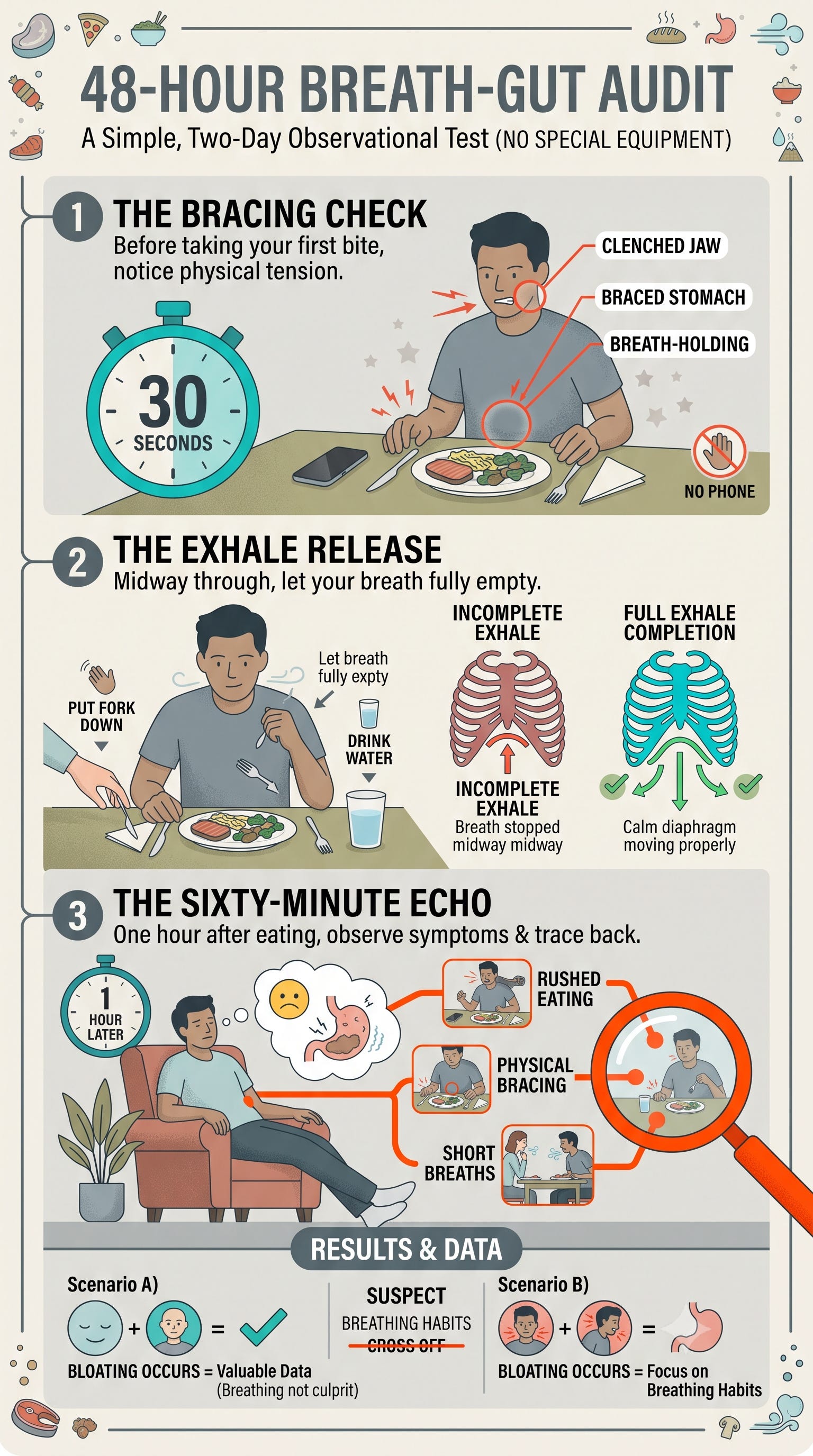
No expensive capnometer device to measure CO₂. No overly prescriptive breathing protocol to follow. Just three checks, run at every meal for two days.
1. The bracing check. Before your first bite, sit still for thirty seconds. No phone. Don’t try to fix anything. Just locate the tension. Is your stomach braced right now? Is your jaw set? Are you holding your breath while you wait for the food to come? Noticing the brace is the work. Braces tend to soften when they’re seen.
2. The exhale release. Partway through the meal, the first time you set your fork down to reach for your water, stop there. That break is your cue. You don’t have to remember to find the moment, because the moment finds you. When you breathe out, does the air empty on its own, or do you stop it halfway and force the next inhale? A tight stomach will not let the diaphragm move. You don’t need to force anything. You just need to stop cutting the exhale short.
3. The sixty-minute echo. An hour after eating, check in. If the bloating or discomfort showed up, don’t reach for a pill yet. Map it back instead. Did it follow a meal you ate in the same state you’d been working in?
And if you eat two days of calm, unbraced meals and the bloating shows up anyway, that’s data too. It does not mean you failed. It means this suspect gets crossed off and your search moves somewhere more productive, which is worth two days of anyone’s attention. A test you can’t fail to learn from is the only kind worth running.
Two days of this and you’ll have something no elimination diet ever gave you: your own data, tied to your own behavior, verifiable without believing a word I say.
What the data gives you back
Once you can see the pattern, your gut stops being that disjointed area under your belt. The distress stops feeling random. It starts tracking something you can actually point at: how braced you were, and when.
That’s a harder truth than a food sensitivity list. It’s also a better one, because a behavior you can observe is a behavior you can change. Nothing to buy. Nobody to depend on.
And work was never really the point. It was just my easiest place to catch my gut in the act. The tension is the part you can feel. The chemistry is the part you can’t. Find the one you can notice and you get a handle on the one you can’t, and that works on far more than digestion. What you’re actually practicing is reading your own machinery instead of outsourcing it. Run the audit on your gut first. The skill you walk away with is the one that matters: learning to trust your own body’s data over anyone else’s story about it.
Most approaches to a stubborn gut work on the contents of the plate. Narrow the list, add the enzyme, chase the sensitivity. This work looks at the conditions the plate arrives into: whether the system was even open for business when the food showed up.
In this approach, nothing gets added. A condition gets noticed.
That’s what makes it testable in two days rather than two years. You are not adopting a belief about breathing. You’re checking one thing: whether the way you breathe at meals is deciding how those meals go.
Your gut may not be reacting to what you ate. It may be reacting to the day you ate it in, and picking its own moment to say so.
It took me decades of meds, hospitalizations, and pressure-filled careers to find this. It should not take you that long.
This essay is part of a larger framework being built at Health Under Control, one that applies the same logic across physiology and psychology. If this way of thinking resonates, there’s more here.
The breathing behavior work here draws on the clinical psychophysiology of Dr. Peter Litchfield, and I found my way to it through the HRV researcher Stephanie White. The synthesis, framework, and application are my own. Any distortions or errors are mine, not theirs.
This essay explores a core application of HUC Principle 1: Self-Verification over Expert Dependency. The audit isn’t a protocol to follow. It’s a test you run on yourself, that resolves either way, and that leaves you holding the result instead of me.
For the foundational framework behind this approach, see The HUC Principles and Five Stages of Health.